
How to Check Criminal History in Orlando
Begin with the office that made the record. Orlando Police Department records staff can locate an OPD case or arrest report, CAD material, and other releasable city-police files. The city request system is the best first stop when OPD handled the call. For prosecution details, search the Orange County Clerk's my eClerk criminal records search. Current custody and recent intake belong to Orange County Corrections, not OPD. FDLE supplies the statewide compilation.
A careful Orlando criminal record check uses several identifiers and compares dates. A common name can return unrelated court cases. An arrest charge may also change when the State Attorney files an information. Use this order:
- Request the OPD report with the incident date, location, case number, names, and exact record sought.
- Check Orange County Corrections for current custody or the recent daily booking report.
- Search my eClerk by name, case number, citation, or a narrow filing-date span.
- Read the docket, charge counts, disposition, and available images instead of relying on a result banner.
- Use FDLE's official statewide search or personal review process when Orange County alone is too narrow.
Orlando Police Record Requests
The city's public-record request workflow accepts requests without a preexisting account. Select Orlando Police, describe the product, and add the date, case number, people, address, or keywords that let staff identify it. Contact details are generally optional under Florida law, though an email makes status and fee notices easier. The city says a confirmation, request number, and any fee notice should arrive within two days. An estimate above $100 requires a deposit.
| Portal control | Useful entry |
|---|---|
| Record description | Exact report, CAD entry, arrest file, or other product |
| Department | Orlando Police |
| Locators | Date, case number, names, location, and keywords |
| Attachment | Optional supporting document when shown |
| Account | Not required before the first submission |
The portal is a request channel, not a live criminal-history database. Staff may need time to review body-camera material, victim data, active-investigation content, and protected identifiers before release.
The Orlando Police Department
OPD Headquarters is at 1250 W. South Street, Orlando, FL 32805. The public lobby is open weekdays from 8 a.m. to 5 p.m.; Records Unit policy hours are 8 a.m. to 4:45 p.m., excluding holidays. Call Records at 407-246-2406 or email opdrecords@orlando.gov. The department's general number is 321-235-5300. Mail requests go to Orlando Police Records, P.O. Box 913, Orlando, FL 32802. The City Clerk, 400 S. Orange Avenue, 407-246-2148, records@orlando.gov, is the city's legal custodian.
The official OPD records page explains report types, payment, and service notices.
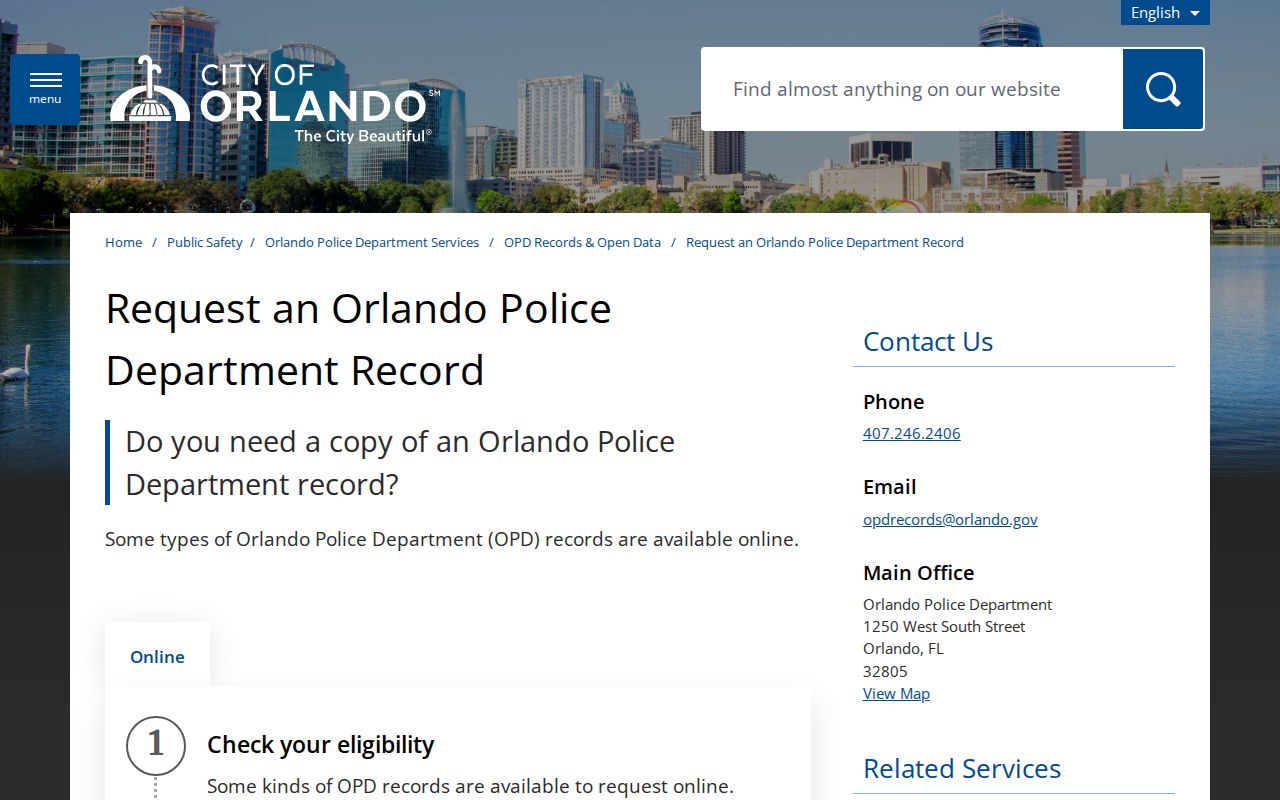
This city source is the place to verify current counter service before traveling. Business checks or money orders work for the stated counter and mail channel, as do counter credit and debit cards; cash and personal checks do not. Traffic crash reports follow the separate FLHSMV route.
Orlando Local Checks Have Limits
OPD policy describes a $10 local records check. It may be completed while a person waits or by mail within three business days, but current in-person availability should be confirmed. The key limit is scope. An OPD check does not include FCIC or NCIC and is not a statewide or national fingerprint result. It reflects the local records the city can lawfully release.
For a Florida-wide name search, use the FDLE Criminal History Information on the Internet product, which costs $25 per search. Someone reviewing their own identity-matched Florida record should use FDLE's fingerprint-based personal review and challenge process. Those channels answer questions an Orlando-only check cannot.
Arrests and Bookings in Orlando
OPD officers create the city arrest report and probable-cause account. People accepted into custody are booked at Orange County's Booking and Release Center at 3855 S. John Young Parkway. Orlando does not maintain a separate city jail roster. The county current-inmate database refreshes every 30 minutes and removes a person after release, while the Daily Booking List provides a recent intake snapshot.
The official booking report uses the arresting-agency label ORLANDO PD. Its fields may include booking number, case number, charge, statute, degree, bond, and custody facts. That label identifies the arresting agency. It does not mean OPD holds the complete jail file or court docket. A reader seeking the officer's narrative asks OPD; one seeking custody asks Corrections; one seeking the prosecution asks the Clerk.
Orlando Police App Record Shortcut
The official OPD App page describes Active Call Updates, Neighborhood Incidents, city events, crime-prevention material, and a shortcut to Records Request.
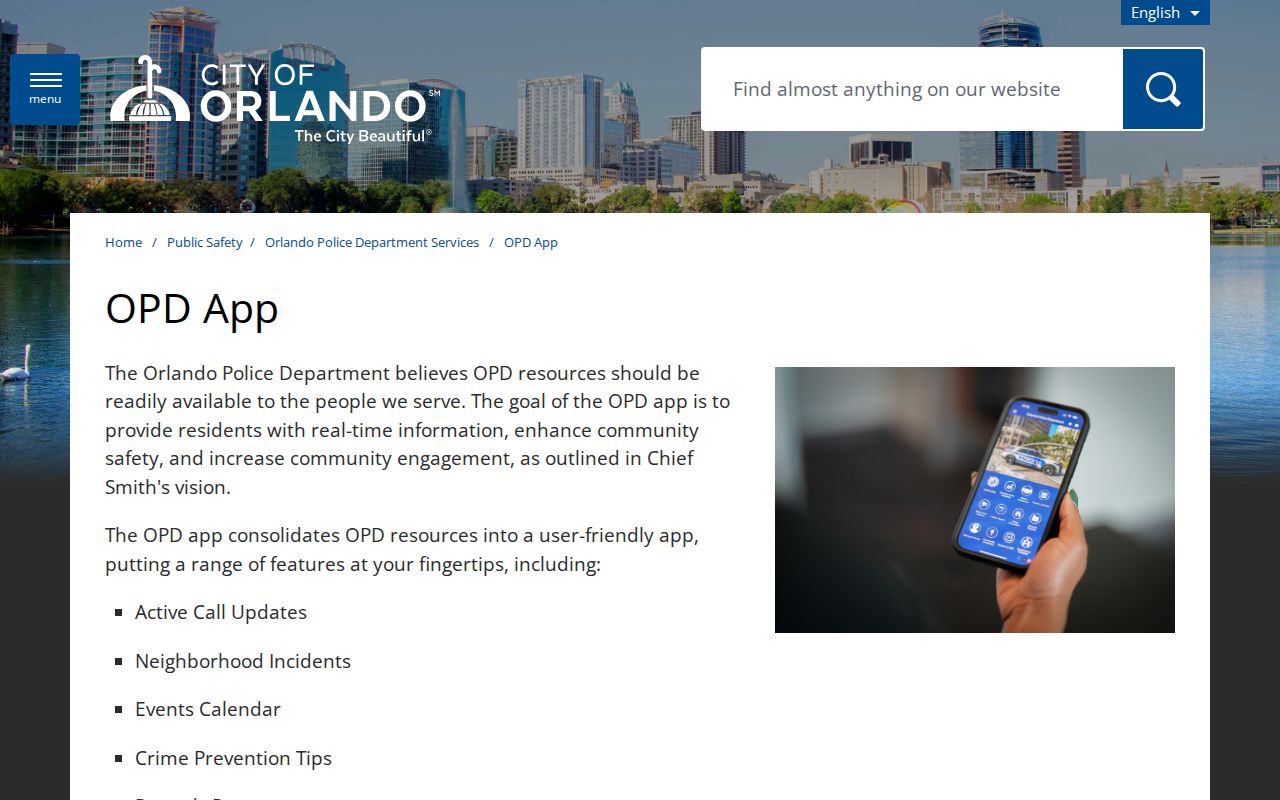
The app can shorten the route to the request form, but it does not turn active-call or neighborhood data into a certified report. Use the underlying OPD record request for a releasable agency document and my eClerk for the later court case.
Orlando Municipal Court Records
There is no standalone Orlando municipal criminal court. Orange County Court hears municipal-ordinance prosecutions, misdemeanors, and criminal traffic matters. Circuit Court hears felonies. Both sit within Florida's Ninth Judicial Circuit, and the Orange County Clerk maintains their dockets. Searching for a city-run criminal docket will therefore send a reader to the wrong place.
| Court Name | Orange County Court and Circuit Court, Ninth Judicial Circuit |
|---|---|
| Case Types Heard | Municipal ordinance, misdemeanor, criminal traffic, and felony cases |
| Case Lookup Channel | my eClerk online, Clerk record request, or Criminal Division counter |
| What the Docket Shows | Case number, parties, charges, events, hearings, disposition, sentence, bond, and public images |
| Copies & Fees | Online docket access is free; requested or certified copies may carry quoted fees |
The online docket generally reaches about 1990, and many images begin around 2009. A missing older image is a reason to ask the Clerk, not proof that no case exists.
Orlando Incident Tools Differ
OPD's public-data hub connects readers with Active Calls, an ArcGIS Crime & Cases Dashboard, and Citizen Connect dispatched-call mapping. Each is an event or context tool. Active Calls is the most immediate view. Citizen Connect places dispatched activity on a map. The dashboard groups and filters reported crime data. None is a conviction search, and an incident point does not establish guilt.
The city's September 2025 progress release reported year-to-date declines in violent crime, residential burglary, and homicide. Those figures are city-reported comparisons for that period, not a full annual UCR table. A searcher should keep the source, date span, and geography attached to any number instead of treating a policy release as an individual record.
Where Orlando Records End Up
An OPD event can produce several files. The officer's report stays with Orlando. Orange County Corrections adds a booking entry when it accepts the person. The State Attorney may file charges that differ from the arrest wording. The Clerk then records motions, hearings, disposition, and sentence. Fingerprints and reported case outcomes flow into FDLE's central repository.
Record flow: Orlando PD › Orange County Courts › Florida Department of Law Enforcement
Timing explains many mismatches. A booking can appear before a clerk case. A released person drops from the live inmate list, while the court docket remains. FDLE depends on agency submissions and later disposition reporting. Compare identifiers and ask the originating office to correct its own record.
Orlando Records Across Neighborhoods
Orlando grew from the Fort Gatlin and Jernigan settlement, took the Orlando name in 1856, and incorporated in 1875. Today, locations as different as Parramore, College Park, Lake Nona, Washington Shores, Mills 50, Thornton Park, Downtown, and the airport area can all appear in OPD data. A precise street address, cross street, neighborhood, and date can be more useful than the word Orlando alone.
The official Orlando Police Department overview supplies headquarters context.
That city identity matters when a mailing address says Orlando but the responding agency was OCSO or another jurisdiction. Request the report from the agency named on the event or case paperwork.
When Orlando Records Seem Missing
A no-result screen has several possible causes. The person may have been released from the live jail list. The State Attorney may not have filed a case yet. A name may be spelled differently, a result may fall beyond my eClerk's 500-item cap, or an older image may require a Clerk request. Juvenile, sealed, expunged, victim, and active-investigation material can also be restricted.
Try the source chain instead of repeating one search. Ask OPD for its report, check the Daily Booking List, narrow my eClerk by middle name or date, and request an older document from the Clerk. For the broader county workflow, the Orange County criminal history overview distinguishes police, corrections, court, and FDLE holdings.
Public Access Rules
Florida provides broad access to nonexempt public records, and a requester need not state a purpose or use a special form. That right does not make every line public. Orlando may redact active-investigation details, juvenile information, victim identifiers, security material, and protected personal data. Court confidentiality follows a separate court rule. A custodian should identify the exemption used for withheld material.
Key Statutes:
Florida Statutes section 119.07 permits inspection and copying of nonexempt agency records and reasonable fees.
Florida Statutes section 943.053 governs FDLE criminal-history dissemination and charges.
Florida Rule 2.420 governs confidentiality in court records.
Use released records to understand a case, review your own file, or conduct lawful research. The original custodian remains the right office for context and corrections.