
Criminal Cases in Orange County Courts
Orange County criminal court cases run through two trial courts in Florida's Ninth Judicial Circuit. Circuit Court hears felonies. County Court hears misdemeanors and criminal traffic matters. The Clerk of the Circuit and County Courts keeps the public docket, filed papers, hearing entries, disposition, sentence, and financial ledger for both. A city police department does not keep the certified court outcome, and Orange County Corrections does not hold the full case file.
The Orange County Courthouse is at 425 N. Orange Avenue, Orlando. The Clerk's Criminal Division works from Suite 210, from 7:30 a.m. to 4 p.m., and can be reached at 407-836-2000. Orange County has no separate municipal criminal court. City ordinance prosecutions enter County Court, while felony charges go to Circuit Court.
Orange County my eClerk Docket Window
The free my eClerk case search is the main remote index. Most Orange County criminal dockets reach back to about 1990, while most document images begin around 2009. The system stops a result set at 500. A broad common-name query can therefore hide useful matches beyond the cap.
Narrow the query with a middle name, date of birth, filing year, or case type. A missing image is not the same as a missing docket. Older pages, confidential papers, and documents marked viewable on request may require staff help. Search absence can also reflect a new booking that has not yet become a filed Orange County criminal case.
How to Search Orange County Case Records
Use the clerk's index first, then move to a record request or counter inquiry when the public view is incomplete. Read every count and the register of actions. The banner status alone may not show that one count was dismissed while another ended in a plea.
- Open my eClerk and choose Criminal Case Records or Search All.
- Enter the defendant's name or the displayed Orange County case number.
- Narrow a large result set by middle name, birth date, year, or case type.
- Open the case and read each charge, docket event, hearing, and disposition.
- Use the Clerk record request or Suite 210 for unavailable copies or a certified disposition.
| Field Label | Type | Required | Notes |
|---|---|---|---|
| Last / First / Middle Name | Text | Conditional | Spelling matters; middle name narrows matches |
| Date of Birth | Date | No | Helps distinguish a common name |
| Case Number | Text | Conditional | Use the displayed year, type, sequence, and location pattern |
| Case Type | Selection | Yes | Choose Criminal, Traffic, or Search All as needed |
| Filing Date Range | Date | No | Useful when a name query reaches the 500-result cap |
Older Orange County Criminal Files
For an older file or a docket image that is not online, use the Clerk's court-record request. Identify the case number, party, year range, and exact document. Contact details, delivery choice, and comments help staff quote the cost and delivery time. Records Management in Suite 150 handles copy workflows, while the Criminal Division counter is in Suite 210.
The official Criminal Court page shows the counter and service details.
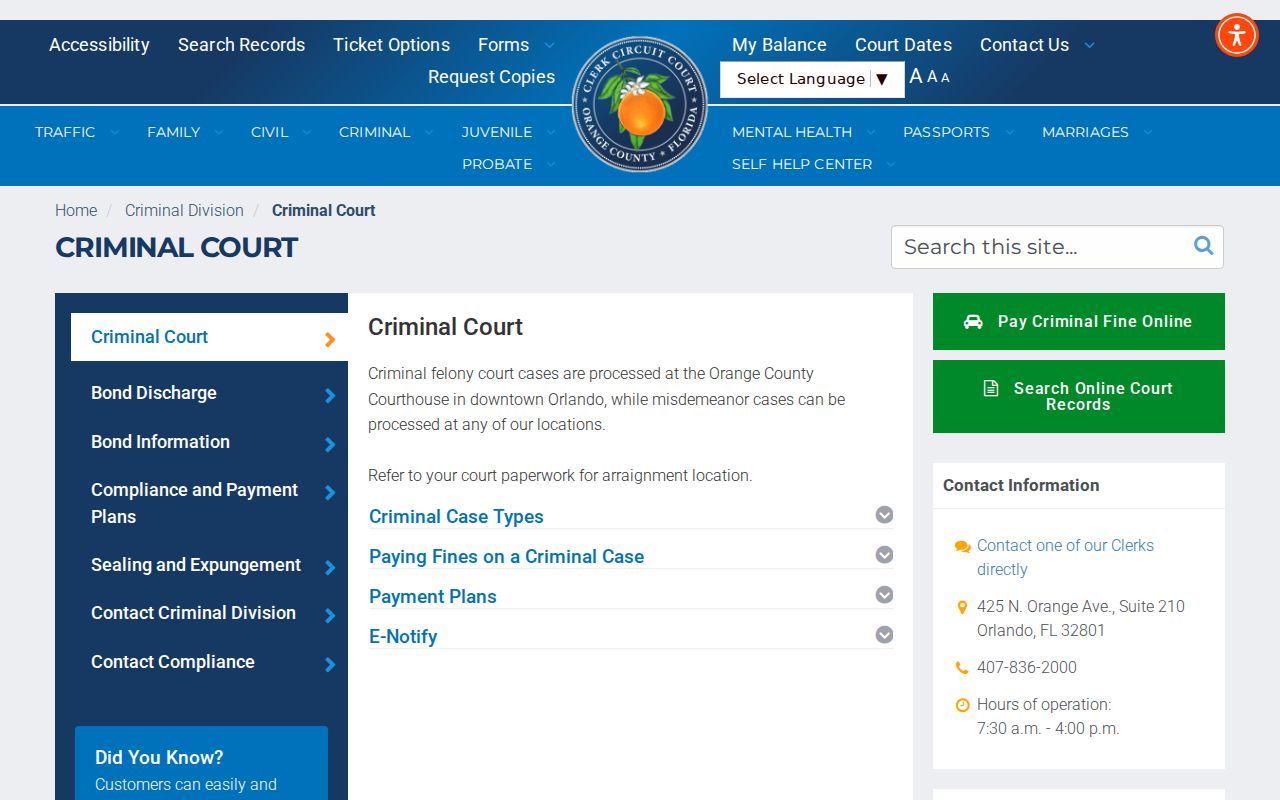
This view helps readers route a court-file request to the clerk instead of the jail or arresting agency.
The online Orange County court-record request page shows the separate copy workflow.
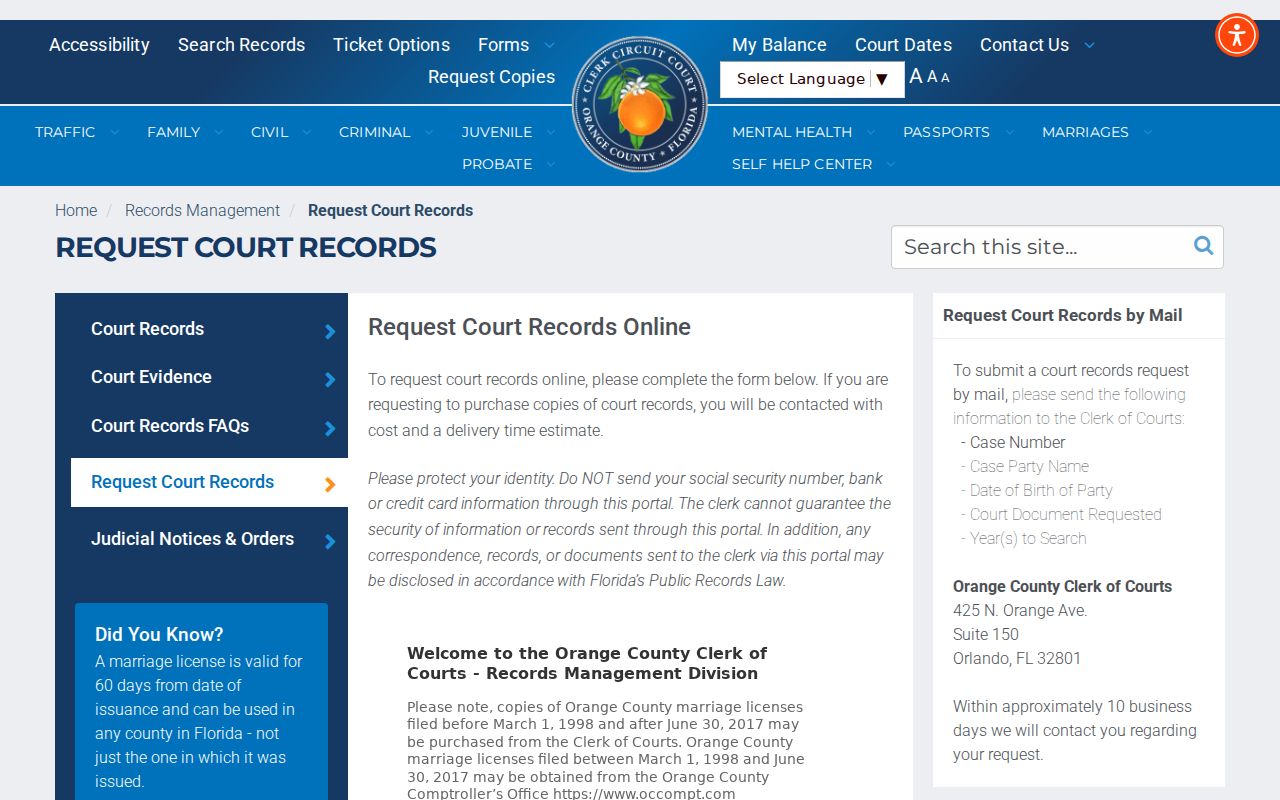
This form is the practical bridge when the docket identifies a paper but the image cannot be opened remotely.
Mail requests should be just as precise. Branch counters can accept some payments and services, but they may not house the paper archive sought. Ask where the file is held before traveling.
What the Orange County Case File Shows
An Orange County criminal case file records prosecution, not just arrest. The charging instrument may differ from the intake charge. Read the party block, each count, the register of actions, and the final judgment together. A docket label does not guarantee that its linked image is public.
| Case Number & Court | Local and uniform numbers, filing date, division, court, type, and status |
|---|---|
| Charging Document | Information or indictment stating the filed counts, statutes, and degree |
| Docket Entries | Filed motions, notices, orders, event dates, and available image icons |
| Hearing Dates | Hearing type, date, time, courtroom or division, and judge |
| Disposition & Judgment | Outcome by count, including guilt, acquittal, dismissal, or nolle prosequi |
| Sentence & Conditions | Jail credit, probation, fines, costs, restitution, and related orders |
Read Orange County Charges Count by Count
A case banner can conceal different results. Pending means unresolved. Nolle prosequi means the prosecutor ended that count. Dismissed also ends it without a conviction, while acquitted or not guilty reflects a merits outcome. Adjudicated guilty is a conviction. Adjudication withheld is not a dismissal and may still affect relief eligibility.
- Information
- The prosecutor's formal charging document.
- Arraignment
- The hearing at which a plea is recorded.
- Nolle prosequi
- The prosecutor stops pursuing a count.
- Withhold of adjudication
- The court withholds a formal adjudication of guilt after the case resolution.
Always pair the disposition with the count number. Then read the sentence and post-judgment entries, since probation violations, appeals, and later orders may follow a disposed banner.
Stages of an Orange County Criminal Case
After an arrest, first appearance addresses probable cause, counsel, and release status before the State Attorney has necessarily made its final filing choice. The prosecutor may file an information, seek an indictment, amend counts, decline the case, or later enter nolle prosequi. Arraignment records a plea. Discovery, motions, and hearings then add entries and orders to the Orange County docket.
Case flow: Charges Filed › Arraignment › Pretrial › Plea or Trial › Disposition › Sentencing
A plea or trial produces an outcome by count. Judgment, sentencing orders, jail credit, costs, restitution, and probation terms can follow. Appeals and postconviction motions may extend the file long after sentencing.
Orange County Court Office Roles
The Ninth Judicial Circuit publishes judge, division, hearing, accessibility, and courthouse information. It does not replace the Clerk's docket. The State Attorney files and prosecutes charges. The Public Defender represents qualifying appointed clients. Neither litigating office is the custodian of the full public court file.

The circuit gateway helps identify the court division while my eClerk remains the place to read the Orange County case register.
The Ninth Circuit State Attorney explains prosecution programs and office roles.

The image marks the prosecutor's distinct role in filing charges, not in certifying the Clerk's final disposition.
The Ninth Circuit Public Defender is the appointed-defense office.

Its case role should not be confused with the public-record access duties of the Orange County Clerk.
Orange County Jail File or Court File
The Booking and Release Center may hold the arrest affidavit, warrant, incarceration order, bond data, and custody status. It does not hold the complete Orange County criminal court case. The Clerk file adds the prosecutor's charging instrument, arraignment, motions, orders, hearings, plea or trial outcome, judgment, sentence, and later case events.
If the question is why police made the arrest, request the agency narrative or jail-held affidavit. If the question is what the State Attorney filed or how the charge ended, use my eClerk and the Clerk. This division prevents a common error: treating an intake charge as the final Orange County court charge. A filing can narrow, replace, add, or decline counts. First appearance can set release terms before that final filing choice is made.
Note: A jail affidavit explains the arrest basis, while the Orange County Clerk docket supplies the filed prosecution and final outcome.
Orange County Case Access and Restrictions
Florida court records generally begin from public access, but the public view is not unlimited. Sealed and expunged files, juvenile matters, protected victim data, confidential identifiers, and some restricted images may not appear. An active sealing order can also change visibility. The public docket may show an entry while withholding its document image.
Under the Florida Public Records Law inspection and copying rule, a custodian may charge lawful copy and extensive-use costs and must apply cited exemptions. For an Orange County case that does not appear, check spelling and date, consider the online coverage window, then ask the Clerk whether a public index or copy exists.